

Last Updated: November 12, 2026
Quick Summary
Clean second story windows safely by first running a five-point check: confirm you can reach the glass without leaning, verify firm and level footing, look up for power lines and hazards, and skip the job in wind. Stop and call a professional if the pole sways on its own or the window is cracked.
- Confirm the glass is reachable with feet planted and shoulders square; never lean or stand on a bucket.
- Check that the ground is level, dry, and firm before extending the pole.
- Keep the pole and water stream well clear of power lines and loose gutters.
- Postpone the job if steady wind makes the extended pole hard to control.
- Call a professional if a window is cracked, its seal has failed, or overhead lines are within pole reach.
Table of Contents
- How to Clean Second Story Windows Safely Without a Ladder
- Best Tools for Cleaning High Windows
- How to Clean Upstairs Outside Windows From Inside
- How to Clean Double-Hung Windows That Don’t Tilt
- When to Call a Professional
- Frequently Asked Questions
Second story windows are one of the trickiest jobs around a house, and most homeowners put them off for good reason. Sunshine Window Cleaning has over 30 years of experience serving homeowners in the Treasure Valley. Below, we cover how to clean second story windows safely, what tools help, and when to call a professional.
Second story windows are the panes on the upper floor of a home, usually out of reach from the ground without a ladder.
How to Clean Second Story Windows Safely Without a Ladder
You do not need a ladder to clean upper windows, but you do need a deliberate risk assessment before the pole comes out. The job usually goes wrong at the setup: soft ground, a gust of wind, or a pole extended past the point you can control. Run this five-point check every time.
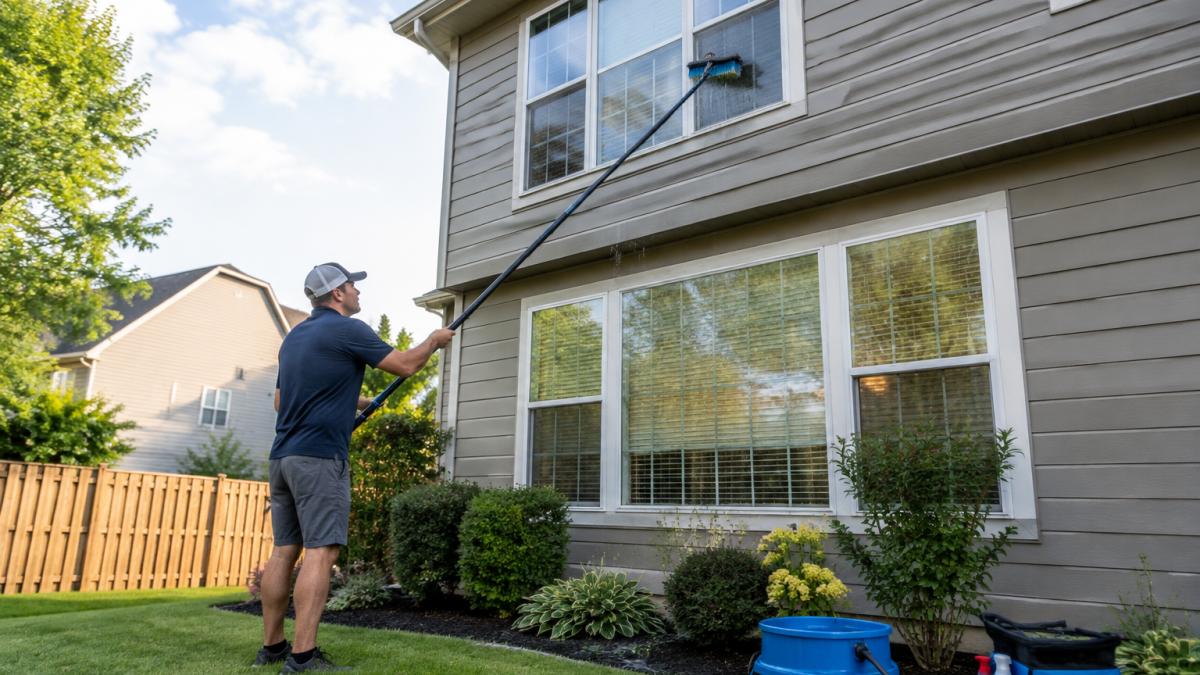
1. Reach. Stand where you will work and extend the pole to the farthest pane. If the tip cannot reach the glass with your feet planted and shoulders square, the window is out of range. Do not stretch, lean, or step onto a bucket, rail, or chair.
2. Footing. Confirm the ground is level, dry, and firm. Spongy grass, gravel on a slope, mulch beds, and gapped deck boards are poor footing. Keep your weight centered over your feet and never lean on the pole; it guides the cleaning head, it does not support you.
3. Overhead hazards. Look up before you look at the glass. Identify power lines and service drops, tree limbs, loose gutters and downspouts, satellite dishes, and hardware that could snag the pole. Keep the pole and any water stream well clear of electrical lines.
4. Wind. Wind is the most common reason to postpone. A pole acts as a sail once extended, and a water-fed stream drifts. If you feel steady wind or see small branches moving, the pole will be hard to control at full extension.
5. Window condition. Inspect the glass and frame first. Cracked panes, failed seals with fogging, loose storm panels, peeling paint on wood sashes, and damaged screens all change the plan. A cracked pane can fail under pole pressure; a failed seal will not clean up no matter how much solution you apply.
Once the area passes the check, work in small sections. Rinse the glass to float off grit, apply solution, scrub gently with a soft head, then pull a squeegee top to bottom and rinse the blade between passes. Move the pole, not your body.
Best Tools for Cleaning High Windows
A good setup makes ladder-free cleaning much easier. Look for these basics:
- A telescoping or water-fed pole that reaches your upper windows
- A soft scrubbing brush or cleaning head
- A squeegee with a fresh rubber blade
- Purified water to help prevent spots
If you want professional-grade options, you can browse our window cleaning tools and supplies for ideas.
The article lists the basic tools that make ladder-free cleaning easier:
| Tool | Purpose |
|---|---|
| Telescoping or water-fed pole | Reaches upper windows |
| Soft scrubbing brush or cleaning head | Scrubs gently |
| Squeegee with fresh rubber blade | Removes water and solution |
| Purified water | Helps prevent spots |
How to Clean Upstairs Outside Windows From Inside
Cleaning the outside of an upstairs window from inside only works on some window types. Open the window fully, clean the glass with a damp microfiber cloth, and keep one hand on the sash for support. If you would rather not handle upstairs exterior glass yourself, you can request a FREE QUOTE from Sunshine Window Cleaning.
How to Clean Double-Hung Windows That Don’t Tilt
Non-tilting double-hung windows are the hardest common unit to clean from the ground because the upper sash sits behind the lower sash and the outside face is only partly exposed when open. Match the approach to what you actually have.
Double-hung, non-tilting. Clean the sill and frame first, then work the glass as far as you can reach with a damp microfiber cloth or short-handled squeegee through the opening. On the upper sash, clean the exposed portion only; do not force the sash or pry at the stops.
Double-hung, tilt-in. These are the easiest upper windows to clean yourself. Unlock the sash, tilt both sashes inward, and clean the exterior glass from inside with a microfiber cloth and squeegee. Support the sash with one hand and do not let it swing free on its pivots. Tilt-in units are the one type where interior cleaning genuinely replaces exterior work.
Casement. Casement windows crank outward and expose the exterior glass at an angle. Open the sash fully, clean the exterior face through the opening with a damp cloth, and wipe the crank and hinges dry afterward. Do not use a water-fed pole stream on an open casement; water will run into the frame and track.
Fixed (picture) windows. Fixed units have no sash to open, so the exterior face is reachable only from the ground with a pole or by a professional. Never remove stops or trim to get at the glass.
Storm windows. Storm panels are removable on many homes, and removing them is often the safest way to clean both the storm glass and the prime window behind it. Label each panel and its location, set them on a padded surface, and reinstall the same day.
Which methods are unsuitable. Do not use a magnetic window cleaner on double-hung units with wide frames or deep meeting rails; the magnets lose grip and the inner unit can fall. Do not use a pressure washer on any window type; the stream can force water past seals and damage frames.
For stuck, painted-shut, or older units, the safest choice is often to leave them to a trained crew. Our team at Sunshine Window Cleaning is IWCA trained and can handle these tricky windows for you.
When to Call a Professional
Call a professional if your upper windows are very high, your roof is steep, or the ground is uneven. Our gutter repair service can also help if clogged gutters are causing water to run down your glass.
BUTTON: Get Your Free Quote
CARD_TITLE: Ready to skip the ladder?
CARD_TEXT: Sunshine Window Cleaning offers fully licensed, insured window cleaning for homes across the Treasure Valley.
Frequently Asked Questions
What is the safest way to clean second-story windows?
The safest method is to avoid ladders entirely and work from the ground with a telescoping or water-fed pole. Before you start, check for overhead power lines, confirm the ground is level and dry, and make sure someone knows you are working outside. Use a pole that reaches the window without extending so far that it becomes unstable. Rinse, scrub, and squeegee each pane from the bottom up. If a window is too high, too fragile, or set on a steep roofline, hire a licensed and insured professional rather than climbing.
Is vinegar or dish soap better for cleaning exterior windows?
For most exterior glass, a mild dish soap mixed with water works well because it lifts dirt without leaving much residue. Vinegar can cut mineral deposits and hard-water spots, but it should be diluted and rinsed thoroughly, and it can harm rubber seals or painted frames if left on too long. A dedicated glass cleaner is another option. Test any solution on a small, hidden area first, and always rinse before the glass dries to prevent streaks.
How do you clean double-hung windows that do not tilt?
Double-hung windows that do not tilt in can still be cleaned from the outside using a pole, but you will need to reach both sashes. Slide the bottom sash up and the top sash down as far as they will go, then clean the exposed glass. Because you cannot access the inside face of the outer pane, focus on the outside surface and remove the screen first if it blocks your pole. If hard-water deposits are present, use a diluted vinegar solution, rinse well, and squeegee dry.
